|
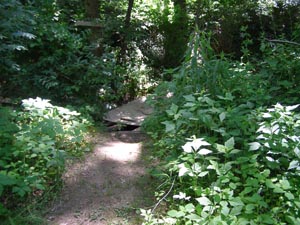
All the Tiger Mothers and Helicopter Parents can raise their children as they see fit. My kids are already reaching their potential through mud...and sticks, and rocks, and trees, and salamanders. Really. In an age where children rush from one activity to another, hooked up to electronic gadgets between stops, it’s hard to overestimate the value of getting dirty. In fact, I’m trusting my children’s futures to it. Our backyard creek bed has become a powerful mentor that has nothing to do with me. The kids have named it by themselves. They make their own laws, build their own bridges and dams, and vote for their Mayor. In fact, other than occasionally asking me to navigate the raspberry bushes that guard the entrance to this land they’ve named Parisville, they forget that I even exist while they’re there. Once they slip past the last swinging branch, they enter a domain that is their own. Oh, I have gone through there a few times. When we got our puppy, he was forever running away to the farm on the other side of the gully. One day, late for a business event, I dragged our wayward dog by his collar over rocks and through bushes to bring him home. My heels sank into the wet mud of their town, leaving perfect holes like some new child workman had been there, carefully arranging a row for future pylons to support a new building project. It wasn’t until I got to the meeting that I realized my carefully chosen sweater and skirt were covered with small burrs. My kids are spaced out like East Coast hurricanes, or really deep snow storms, one every four years or so and, luckily for them, there are plenty of playmates of all ages in our neighborhood. This spread makes for a natural division of labor in Parisville. The ones who can spell make street signs; the oldest ones naturally win the position of Mayor. The little ones are often seen rummaging through the garage bins for Sharpie markers and nails and bottles of Gatorade in order to earn Gold, which looks surprisingly like piles of flat black rocks that they have dug from the creek bed and deposited in the “Bank” under the honeysuckle bush. Being fans of social order, their laws are spelled out in red Sharpie on a big plywood sign that teeters on wobbly legs. No spitting. No stealing. No hitting. Only the Mayor can approve building plots. Clean up your garbage. No stealing the Gold. Hotel costs three Gold rocks. Inevitably, there is a citizen who pushes the envelope and stays at the “hotel” without paying or breaks someone else’s dam to see what happens downstream. When this happens, they don’t run out of the woods to tattle on the offender. No one has to give a lecture on playing nice or taking turns. They have figured out how to handle their problems on their own and, thankfully, their solutions look more like “Perry Mason” than “The Lord of the Flies.” Behind the big plywood list of rules, there is a small space, topped with a crooked sign that reads, in shaky red letters: “JAIL.” It is guarded on either side by spindly branches of pricker bushes, which are arranged around the sides like horizontal prison bars. Just like in our world, the jail seems to have a rotating door for certain kids: the ones who smile and stand a little taller while they are “arrested” in front of the other kids, their reputation getting stronger with each infraction. Once they are “locked up,” they squish their toes in the mud and lean against the damp creek bed, listening to the cracking of sticks and the voices of their friends, while contemplating the puny branches that are their bars. Oddly, few jail breaks occur, considering the limited level of security the jail provides. There is something so timeless about the sounds of their play as they hammer and call to one another, scurrying through the bushes for supplies. Sometimes, I sit on the back deck listening to their voices, knowing that their play will go on without me, even as night begins to fall and the birds sing their last songs of the day. As I listen, I realize that we all are blessed. In Parisville, they have built roads, bridges, steps, railings, signs, hotels, chairs, restaurants, rope swings, fish ponds, salamander traps, and a Mayor’s office. Even though there are vines for cords, bark for controllers, and plenty of rocks for television screens, I can happily say they have never built a replica of an Xbox in Parisville. Their play is not about competing or excelling or living up to someone’s expectations. Like their parents’ and grandparents’ childhood play before them, it is about mastering their environment and cooperating to build a community. I am struck by how much we can learn by noticing what children find worth imitating. Our family is facing a time of big changes now. Our oldest is soon leaving for college and our youngest is in Kindergarten. As a mother who has so far refused to “hover,” I trust that the lessons they have taught themselves in Parisville will serve them both well. As my son creates his new life in another state, he will be farther on the other side of Parisville than he’s ever been, making his own choices and inventing his own life. In school, our Kindergartner is confronted with new rules and consequences and all types of children who will shape her world. There is something so timeless about this progression too: the parents becoming less and less relevant, sitting in the background listening to the winds of change. In my heart, I know that their lives are going to turn out exactly as they are supposed to. If it all goes as well as I expect, I will give full credit to their summers in Parisville. Ann Schuster is the mother of four children in Bucks County Pennsylvania, and believes that everyone should spend more time playing in our natural environment. She is the recent author of a children’s book called “Woodland Playground,” which is being published on Amazon.
|
|