Sleeping With Your Baby
with Dr. James McKenna
Cosleeping with a baby is common in many parts of the world. But it’s controversial in North America, where some medical organizations warn that it can cause suffocation. Here is another perspective from James J. McKenna, Ph.D., author of a book on the subject called Sleeping with Your Baby: A Parent's Guide to Cosleeping (Platypus Media, LLC, 2007). Dr. McKenna directs the Mother-Baby Sleep Laboratory at the University of Notre Dame. He has been studying cosleeping for over 30 years.
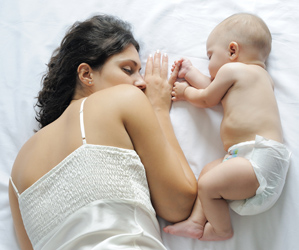
Q: Does cosleeping benefit babies?
A: Benefits are, of course, always relevant to whom is cosleeping, what it means to them, and how they practice it. Cosleeping makes babies happy. From a scientific point of view, cosleeping babies cry less and sleep more. Babies lying next to their mothers can breastfeed easily without having to cry in order to make their needs known. Mothers get more sleep, too (though it is more light sleep.) Here in North America, we are the most unsatisfied, unhappy and exhausted parents in the world because we place babies at odds with their biology.
Q: Isn’t cosleeping dangerous?
A: Sleeping alone is not biologically correct. Human infants are born more neurologically immature than any other species (excluding marsupials.) Our central nervous systems depend on a microenvironment that is like the in-utero environment, full of sensory stimulation. Babies need the warmth, stimulation and monitoring that comes with sleeping next to a caregiver.
Almost all, fully 95 percent, of the world sleeps with their baby, and there are only very few cultures in the world for which babies sleeping alone is even thought to be acceptable or desirable. In many Asian cultures where cosleeping is the norm, including China, Vietnam, Cambodia and Thailand, Sudden Infant Death Syndrome (SIDS) is either unheard of or rare. In Hong Kong and Japan, which have almost universal cosleeping, SIDS rates are among the lowest in the world. The vast majority of scientific studies on infant behavior and development conducted in diverse fields during the last 100 years suggests that the question placed before us should not be “Is it safe to sleep with my baby?” but rather, “Is it safe not to do so?” My book includes information on how to bedshare safely and when it should be avoided, information parents need to make sound choices.
Q: Why do parents always get told that they should never sleep with their babies?
A: Parents are receiving dangerous advice from medical authorities that mislead them into assuming that all pediatricians and all SIDS researchers recommend against bedsharing. This is just not true. The American Academy of Pediatrics Task Force on SIDS claims bedsharing is always hazardous. This is flat out wrong! Done correctly, whether this means cosleeping, bedsharing or room sharing, infants sleeping with their parents are more likely to survive! The U.S. Consumer Products Safety Commission says never sleep with your baby; the only safe place for an infant to sleep is in a crib that meets current safety standards.
It is sad that a small group of “experts” have the parents in western countries bamboozled into believing that the entire history of civilization was wrong, that parents and babies have been doing it all wrong since the dawn of humanity!
Q: Should parents rely on doctors for infant sleep advice?
A: One of the most important things I am hoping to do is remind parents that while professional evaluation is important for sick children, issues of childcare, especially regarding where babies sleep and the relationship this reflects, are decisions best made by information-armed parents, not by external authorities who neither know the parents, nor the infant, nor how sleeping arrangements might work in any given family. At this point in time, medical authorities seem overly willing to use selected and simplistic medical findings to infer their own conclusions about where babies should sleep. Many employ, in my mind inappropriately, a one-size-must-fit-all strategy for sleeping arrangements. Indeed, cosleeping is being misrepresented – often by people who think they know something about it but choose to dismiss any scientific evidence that disagrees with their own negative position. Many of these authorities only know about catastrophic failures associated with dangerous forms of cosleeping and use these failures to draw simplistic conclusions about a very complex practice.
Q: Won’t my child be emotionally dependent if we cosleep?
A: Absolutely not! Independence and autonomy have nothing to do with forcing babies to learn how to sleep by themselves. Parents are often under the mistaken impression that if they don’t train their babies to sleep alone every night, somehow some developmental or social skill later in life will be kept from them, or that their babies will never exhibit good sleep patterns later in life. Yet research has consistently shown us that children who routinely sleep with their parents or are not “sleep-trained,” actually become more independent socially and psychologically, are able to be alone better by themselves, and have greater abilities to interrelate and be empathetic.
Q: Do you believe that all parents should cosleep with their babies?
A: No, I believe parents should do what they feel is best for their families. I think it is important to empower parents and let them know that every child born in the world is unique as is each family. Since no child is the same, no solution to what children need is necessarily the same. Parents know their own babies better than anyone. Pediatricians are not trained in human development, childcare strategies or psychology. They know how to fix sick babies. We have to be very careful to not medicalize behaviors that are not appropriately medicalized: where babies sleep, what is a proper sleeping arrangement and how parents decide to respond to their baby’s nutritional needs. I do believe that parents should be well-informed so that they are able to make the best decisions for their families, and so that if they do choose to do something like share a bed with their baby, they can do it as safely as possible.
|